- Introduction
- Sunday, May 6
- The Airplane
- Monday, May 7
- Arrival
- Tuesday, May 8
- Tsfat and the Golan
- Wednesday, May 9
- Archaeology in the Galilee
- Thursday, May 10
- Haifa and Area
- Friday, May 11
- Toward Jerusalem
- Saturday, May 12
- Shabbat in Jerusalem
- Sunday, May 13
- The Old City
- Monday, May 14
- Sick in Jerusalem
- Tuesday, May 15
- Into the Negev
- Wednesday, May 16
- The Dead Sea
- Thursday, May 17
- Masada
- Friday, May 18
- Tel Aviv-Yafo
- Saturday, May 19
- Shabbat in Tel Aviv-Yafo
- Sunday, May 20
- Home
Wednesday, May 16: The Dead Sea

Mike at Kibbutz Lotan
Slept through this week's services. Definitely feeling better in the morning. Not so Annecke, alas, but at least she had medication now. We had a tour of Kibbutz Yahel: very inspiring stories about cooperation between rugged dwellers of Israeli desert and rugged dwellers of Jordanian desert. In this part of the country, the border consists of a double line of fence, not even barbed wire, with 50 metres of no-man's land between. And each side with a military road right against the fence, for regular patrols that never find any trouble.
Next: Kibbutz Lotan, another Reform kibbutz but this one socialist and environmentalist, in contrast to Yahel's capitalism. Such contrast, and they're neighbours. Such a country of contrasts this is: so many varieties of everything in such a small space.
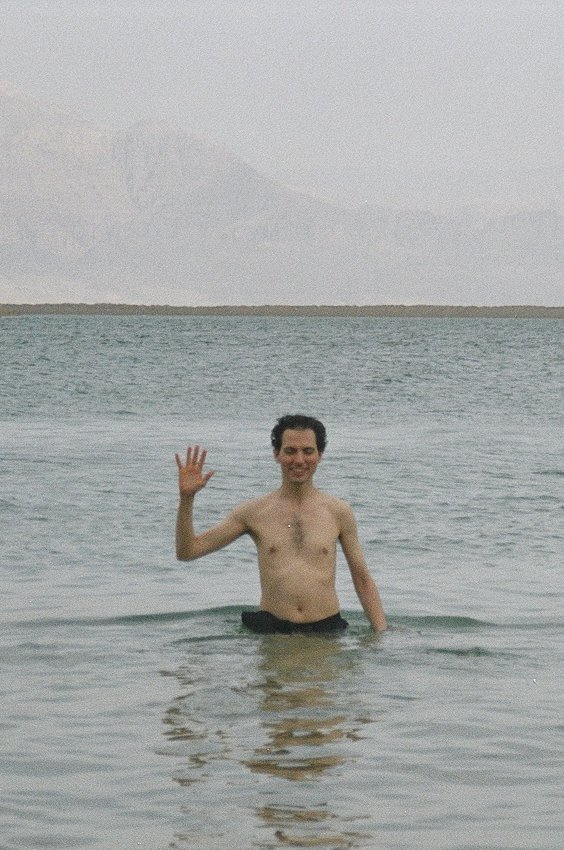
I in the Dead Sea
North and down. Down, down to sea level and lower—418 metres lower, according to Wikipedia, but changing annually, more on that later—to the shore of the Dead Sea. (Yeah we stopped at the Ahava factory, but they didn't even bother to show us a video so I'm not going to mention them.) The Dead Sea was actually really nice. Michael, Brenda, and I, along with John and Susan, went for a float. I won't say a swim, because you can't swim in the Dead Sea: the buoyancy is too great. Brenda said it was like floating in JELL-O(tm). Not a bad analogy. Not gelled JELL-O(tm), but JELL-O(tm) after you've prepared it and let it sit for a bit. Also you can't drink the Dead Sea because it's extremely salty and also poisonous, not to mention too big.
Every so often, the lifeguards would yell something in Hebrew over the loudspeakers. We didn't know what they were saying, so we ignored them. It seemed to be directed toward some people who were floating a bit far from the Israeli shore, and was probably something like "don't go out so far, you idiot". Everyone else was ignoring them too, so we figured it was all right.
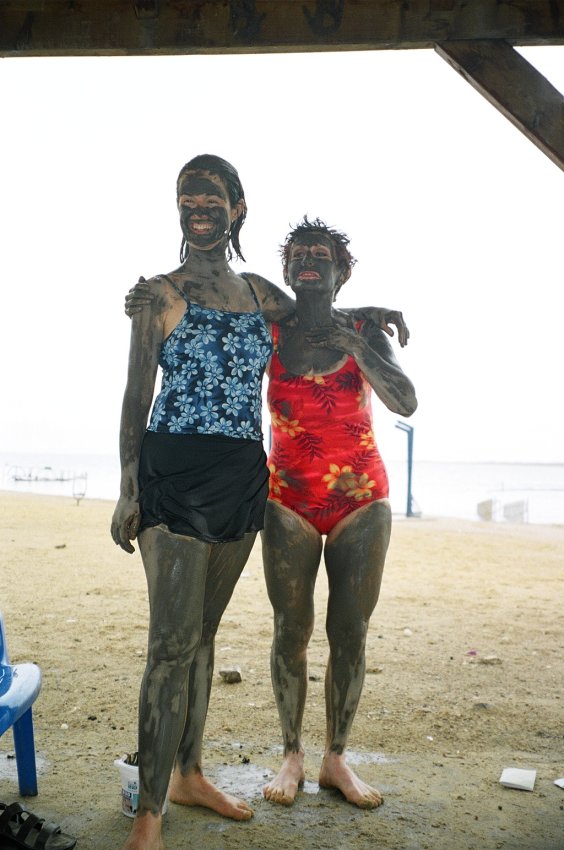
Brenda and Susan in mud
The sand on the shore isn't really sand: it's salt. As we came closer, we passed a whole mountain of salt. It's because the Dead Sea has no outflow. Rivers—especially the Jordan River—come into it, but the only way water gets out is by evaporation. There's a lot of evaporation because the region is really hot and dry, and in fact when you combine that with the fact that Israelis and Jordanians divert water from the Jordan River for irrigation it means that the Dead Sea is currently dropping by a meter a year. This has been going on for a while, causing all kinds of problems such as sinkholes, so the two governments have decided to pipe water in from the Gulf of Aqaba to the south, with ancillary benefits including hydro-electric power and the opportunity to get some desalination going.
After Michael and I got back to our hotel room (2gether 4ever!), he noticed that his glasses were missing. He was prepared to give them up for lost, but I insisted we retrace our steps down on the beach, and lo and behold we found those glasses still sitting down there on the shore.
Michael, by the way, felt wonderful there. With the increased air pressure, and in particular a very increased amount of oxygen in the air, he was able to be more active than he'd been anywhere else in the country. It really made a difference. And another little-known side benefit of life at the Dead Sea: owing to the extra atmosphere, fewer UV rays make it to the ground, so you don't get sunburned!
Back to the hotel. Shower(!), dinner, to bed.
Next: Thursday, May 17, Masada